Rav Eliyahu Mani zt"l
הרב אליהו בן סלימאן מני זצ"ל
Tammuz 8 , 5659
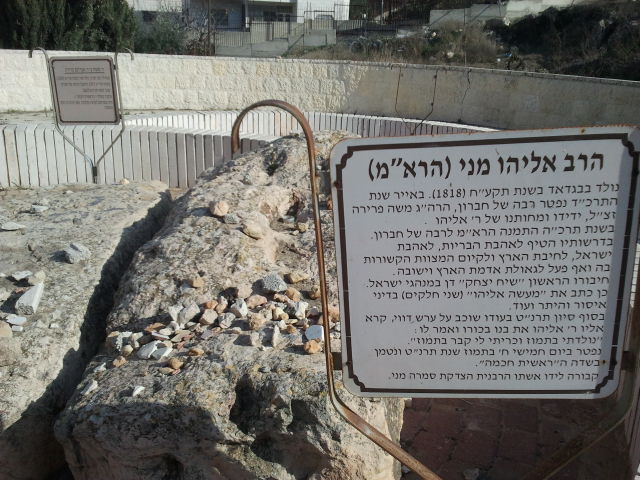
Rav Eliyahu Mani zt"l
Originally from Baghdad, Iraq, he hailed from the Mani family, one of the most distinguished families of Baghdad. According to family tradition they trace their lineage back to Dovid HaMelech. This is what the acronym Mani stands from Mi'Zera N'in Y'ehudah.
He was a disciple of Rav Avraham Yosef known as Rav Abdalla Somech the Zivchei Tzedek and married his sister. He joined the Yeshivah of the Mekubalaim Beis E"l in Jerusalem in 5616 and was supported by his colleague the Ben Ish Chai. The Ben Ish Chai would write to Rav Mani receiving many letters detailing the customs and practices of Eretz Yisroel especially those of Yeshivas Beis E"l. he studied in Jerusalem in Beis E"l under Rav Abulafia. Unfortunately the climate in Jerusalem was unhealthy for him and his household and he fell ill and spent many days sick. Eventually the doctor's orders were for a change of climate and so he moved in 5618 to Chevron were he spent the rest of his life. He became a colleague of Rav Moshe Firera the Rav of Chevron and together they studied, taught and advised and led the Jewish community. When Rav Fierera passed away Rav Mani was appointed to succeed him as Av Beis Din of Chevron. On Yom Kippur 5659 he began to prepare his family and congregants for his approaching passing. He began secluding himself in his studies and avodah. Indeed that very year in Sivan he was bedridden and he told his son, I was born in Tammuz and I have dug my grave in Tammuz and he passed away on 8 Tammuz and was laid to rest not far from the Reishis Chochmah in the ancient bais haChaim in Chevron. He left behind a son Rav Avraham Baruch author of Baruch Avraham.
He authored several seforim: Zichronos Eliyahu on Torah, Kise Eliyahu on Reishis Chochma, A collection of customs and minhagim of Chevron named Bais Yaakov, Karnos Tzadikm minhagim for Bris Milah, Shu"t Responsa Tanna Dvei Eliyahu, Siach Yitzchok
Divrei Torah of Rav Eliyahu Mani zt"l

There was once a man who was ill and his doctors advised him to take various medications and healing herbs. All the medical treatments were designed to help him overcome his illness. The sickness abated and he was cured. Nevertheless, he could not continue to live without food, the basic necessity for life. All the medicine in the world cannot help a person live without food. This parable teaches us the lesson; mussar is the best medicine to help us overcome the sickness of the animal soul and the yetzer hara. However without basic food and nourishment for the soul; the holy Torah itself, we cannot live! He cites the Nefesh haChaim who chastises those who study mussar and works of character refinement while neglecting basic Torah study.
Rav Eliyahu offers another mashal:
Someone was invited to the fancy feast of a wealthy landowner. They served spiced condiments to whet the appetite and make the fancy dishes palatable; courses such as stuffed hens and fat meats, delicacies that need such condiments and spices. This man decided to prepare entire meals solely of such spices and condiments forgetting that he himself would need just bread alone. After consuming these foods he was unable to stomach it! They explained to him that such spices and condiments help a person's appetite for following courses but one cannot make a meal of such foods alone! Rather he should focus on bread the staple of the meal to sate his appetite and quell his hunger. Similarly, he concludes that whoever focuses solely on mussar like a spice to rouse his heart and awaken his mind and soul for avodah, that is great, but how can that help when the actual main meal is missing, when there is no bread, no body of Torah, no corpus of laws. (Siach Yitzachok Introduction pg 35)